We at DLM believe in the power of good writing. We just came across this gem and we hope you enjoy it. If you have an essay that you would like to share, please email Mary Louisa at mlhommedieu@dlmlegal.com.
By Sally Anne Gunn on July 8, 2012
Well, it happened. This evening at about 7 p.m., on my return trip from visiting all the family in Hudson, I watched my car’s odometer roll over 100,000 miles. I was driving along Palmyra Road in Canfield, Ohio, and happened to look down at the instrument panel, to see a long string of nines. It took me a few seconds to realize what was happening; my car was having a significant moment! (At first I thought something was wrong with the car’s something- or-other that I don’t understand – like those little icon codes that you have to pull over and look up in the car’s manual to be sure the engine won’t blow up). I had to pat the dear 2003 VW Passat wagon on its black padded dash board in appreciation of all the places it has safely taken me. Instantly, my thoughts went to the men who have kept me rollin’.
First was my father, Delford Crespi, who was always at one with mechanical things (that could be twisted, pried, screwed, oiled, pounded, and *@^!! at). Every time I got in the family car or pickup truck or tractor, everything worked because he kept it that way. It was a sad day for him when computers became the controllers of car engines; in his 80’s he switched his passion to the riding lawn mower. He could no longer drive a car safely after he was about 85, so he took to driving the lawn mower down the tar and chip road to see the neighbors (he could have walked). When he developed Alzheimer’s –like symptoms, he became just a bit devious: when my mother thought it unsafe for him to keep “driving” the mower, she hid the key and explained to him why she did it. So, with as much stealth as he could muster, he took some aluminum foil, folded it several times and tried inserting it into the ignition. He was always a creative thinker. But it didn’t work. I still wish it had.
When Larry Meehan and I married in 1966, he told me as plainly as possible, that for him to work on a car would only cause problems – or even disaster – as he had experienced in the past. So he felt good about establishing for me an on-going relationship with Bob Giovanni. Bob and his wife Sherri had bought the gas and service station (which used to be) close to the corner of Wood and 3rd Streets in Lowellville, Ohio. His place was a gathering spot for retired men with old football injuries and secure opinions. Bob and Sherri worked long greasy hours there, pumping gas, checking oil, checking tire pressure. All this was BSS (before self-serve). It seemed to me I was always in need of some inexpensive (cheap) way of fixing my car. Bob was a master of what I thought of as chewing gum and bailing wire techniques. He’d get me all manner of used and re-built parts, install them, fix them again, and then tell me the sad tale that nothing remained but to do it right. This all worked on the VW my brother Bernie sold me for a dollar, and on the ’66 Chevy my parents sold me – also for a dollar. Both served me well, even though they were in their waning years. Bob was one of the people who on Thanksgiving Day, as we drove to Mary Elizabeth and Red Meehan’s house, tried to flag down our car to let us know that the glass bowl with (homemade) cranberry sauce in it was riding on top of the car.
I must remember my Luke Skywalker realization. I didn’t get my driver’s license till I was 18. Shortly thereafter, my mom thought I should drive my aunts Frances, Mary & Genevieve to shop in downtown Youngstown one Saturday. With them in the back seat and my mother in the passenger seat, I drove down Wilson Ave./Route 289. Today it means nothing, but in 1963 the Youngstown Sheet & Tube steel mill was operating full throttle, the air so rust –red it seemed you could chew it, with three shifts of workers, and cars parked bumper to bumper on both sides of the street. Driving in well-marked lanes or on country roads was fine with me. But that day I felt that the oncoming and the parked cars were only inches away from me. With my aunts and mother in the car, I was sweating ferociously, and my heart was in my mouth. I made it without harm, but I’ll never forget how I felt. Then one day in 1977, the movie Star Wars came to the Boardman Theater. Betsy McCleod and I took our children to see it. During the movie, Luke Skywalker has to pilot his plane through tight caverns. Luke did it without hitting the walls because he kept his eye on the place he wanted to go, not on the walls he wanted to avoid. After that, every time I have driven through tight places, I become Luke Skywalker.
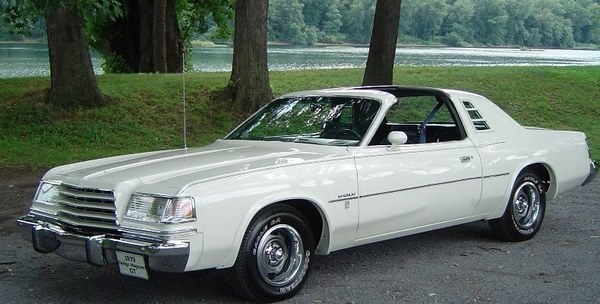
Then there was the Dodge Magnum which Larry bought me for Mothers’ Day in 1978. It was beautiful for its day, with its white body, blue vinyl half roof, white leather upholstery, sun roof and lots of power. Yes! The only day that car didn’t start in the morning was the day it was 14 below zero. I loved it. The kids- Larry, Mary Louisa, Rebecca & Bridget – and I rode everywhere we needed to go in it, sometimes with the sun roof open in the rain; if I drove just the right speed, the rain only sprinkled in and it was great. Of course, nothing’s perfect. One icy winter morning on my way out of Lowellville on Rt. 289 with all the kids in the car (we were going to Kennedy School where the children attended and I taught), I saw an oncoming car that was spinning out of control coming right for us. I slowed to almost no speed and tried to steer up the bank on the right. But the spinning car picked up speed and hit my left front fender. The worst part was that, because it was Bridget’s turn to ride in the front seat, she had lurched forward into the padded (thank Goodness) dash, and her front upper teeth marks were imbedded in it. She didn’t lose her teeth, but it wasn’t a nice way to start the day. The Magnum that was such a pleasure turned its 100,000 mile mark, and it seemed everything started to fall apart. At the end of its wheezing, convulsive life, it used to keep chugging and choking even after the ignition was off. We would just walk away as though the car really wasn’t possessed by the auto demons. The car also would have a hard time staying on after it started. At about this point Bob Giovanni showed my son Larry how to raise the hood and hold a stick in something or other so it would stay on. Then, of course, he had to drop the hood, and quickly jump into the car so we could get going without stalling.
My husband Larry had passed away in 1989, and I was driving the Volvo 760(see: Lemon) many miles for Eastern Sales. One day in Boardman (thankfully not too far from home) it broke down one too many times. I called Tom McIntee (Larry’s cousin, my good friend, and owner of McIntee Motors on Youngstown Poland Road- who had provided us with the above Magnum) and told him my tale of woe. He was a master at enjoying and at the same time sympathizing with phoned in problems. This particular time, I asked him to meet me where I was with a car he thought I might like, and to take away the Volvo so that I’d never see it again. And so the huge, white Chrysler entered my life. The car felt so good. It rode like an ocean liner (without the motion sickness), and there was so much space in the back seat that tall people could stretch out, and I could actually put a furnace or air conditioner on the seat if one needed to be delivered on my sales calls. It had a huge trunk for all the literature, display tables, etc. that I needed, and a sun roof that gave me joy even on bad days. It had a lot of pick up too. I remember being on the Indiana turnpike when an unmarked car behind me slapped a blue light on the roof and wanted me to pull over (heaven knows, I have been known to drive over the speed limit – from time to time), but the car was unmarked, and couldn’t see any uniform, so I drove faster. I figured that at some point I certainly could find a bona fide policeman. He drove faster. I drove faster. Then he pulled up alongside me and put on his hat. So I pulled over. In retrospect, that was probably a wrong move. But it was daylight and there were a lot of cars around. I wish I had had a cell phone; they just weren’t common then.
In that car I drove from a sales & product convention in Chicago to meet Richard Gunn in Cleveland at the Glidden House. He and I had been going out for a couple of months but had had not time to just be with each other. Well, twenty-one years later, just being with each other and my cars, he continues to keep my ride working well: checking the pressure of my tires, taking them to be fixed, balanced, aligned, replaced at Salem Tire Company; checking all those important fluids; determining when my timing belt needed to be changed, being alert to odd-ball sounds, diagnosing and fixing them; making sure error codes are fixed by the dealer, waiting for the people who changed my cracked windshield. He keeps me rolling. My registration and insurance documents are always in the right place, and he puts my sticker on the license plate. It’s no longer a situation in which things get really bad and then need major repair. Of course, ever since I came to live here, I realized I was in a zone of car culture. I once asked stepsons Bryan and Brendan: Do you work for the car, or does the car work for you? My answer is always: The car works for me. Their answer: They work for the car.
Rich always loved cars, and sometimes his memories are framed by the particular car he drove at that time. I guess mine are too. I remember the blue Mercedes he picked me up in for our first date, and his Porsche 911 for our second date. He loved the Porsche and was very territorial about it. I knew my father would love to have a ride in it. I was surprised when Rich handed me the keys and told me to take the car. I loved how the car shifted and how it moved as though it understood my thoughts. I love a car that moves when you tell it to. My father loved our ride up Erskine Quarry hill and around New Castle Rd., returning through Lowellville. He reported to Rich that I knew how to drive that car. (I think Bryan once characterized my driving in another car as an Italian tune up.)
I drove the blue Mercedes 300 for a few years after Rich. It was a tank of a car. Great to drive on anything but ice, but that is with any car. It had wipers on the headlights and one big windshield wiper instead of two. Rich introduced me to All-Wheel Drive and suggested I look at an Audi A6 Quattro which was for sale at a screaming deal. I bought it and loved it. I noticed men (to be sure, all my Eastern Sales customers at the time were men) were entranced by it, looking underneath it, asking questions about the engine (for which I learned a few quick answers) and loving the color – dark blue. The car had good power, but sometimes questioned my decision when I stepped on the gas. When I sold Eastern Sales, and when it was time for Rich to get another car – an Audi A8 Quattro – we decided to try to save a little money on insurance, etc., and share that car. I still had a smaller Dodge pickup truck, and we could use this for all the messy things (plants, dirt, etc.) that I liked to do.
It was a good idea in theory. I really enjoyed driving the A8. However, I have learned through various decades of my life (I must have forgotten earlier forays into that territory), that it is NOT a good idea to share a car with one’s husband, especially if he is terribly neat, always putting certain things in certain places. I think it comes down to philosophy and imagery. My car is like my horse (I never had a horse) and goes where I like to go, as I like to go, racing through mud and parking under trees during the summer. Sometimes, even in the summer, I love the windows and roof open, my hair and any other loose thing blowing around. I love black carpet and upholstery because it doesn’t show if one happens to drop a bit of coffee on it. My car has to be one with me on the road to wherever, and has no fear of dirt, snow, library books, things to be returned to TJMaxx, extra grocery bags, or a stray banana peel.
And so, Brendan Gunn, maybe sensing this, told me about a nice, new but year-old good car he saw at a good price. Since 2004, I’ve owned a 2003 Volkswagen Passat wagon all-wheel drive. I love its tailgate and fold-down back seats. It has a few dings in it, but those don’t mar my enjoyment of it. I usually change the oil when the dealer sticker says, but right now I’m about 1,000 miles over. My Ohio driver license says I am 5 ft. 2 in. tall and weigh 140 lbs. ( not true all the time) and there is a hologram of the seal of Ohio, the outline of the state, and a cardinal, the state bird. I look happy in my picture.
I hope that I get to have my driving keep me independent till I’m at least 85, like my mother. Of her own volition, she stopped driving when she was 85, and she said that not driving was the worst thing in the world. What a wonderful thing: to be able to get into my car and go when and where I want. It allows me to be what I am. Listening to a recorded book in my car now – The Art of Racing in the Rain – the narrator, Enzo the dog has learned from his race car driver man that the car will go where your eyes are focused. My eyes are focused on the distant future, driving through rain and snow and beautiful autumn days, going to places I need to go, want to go, and love to go.

 In a recent enforcement action, the National Labor Relations Board held that a company’s blanket policy requiring employee confidentiality during a human resources investigation violated Section 7 of the National Labor Relations Act. This section of the Act gives employees the right to “engage in concerted activity.”